

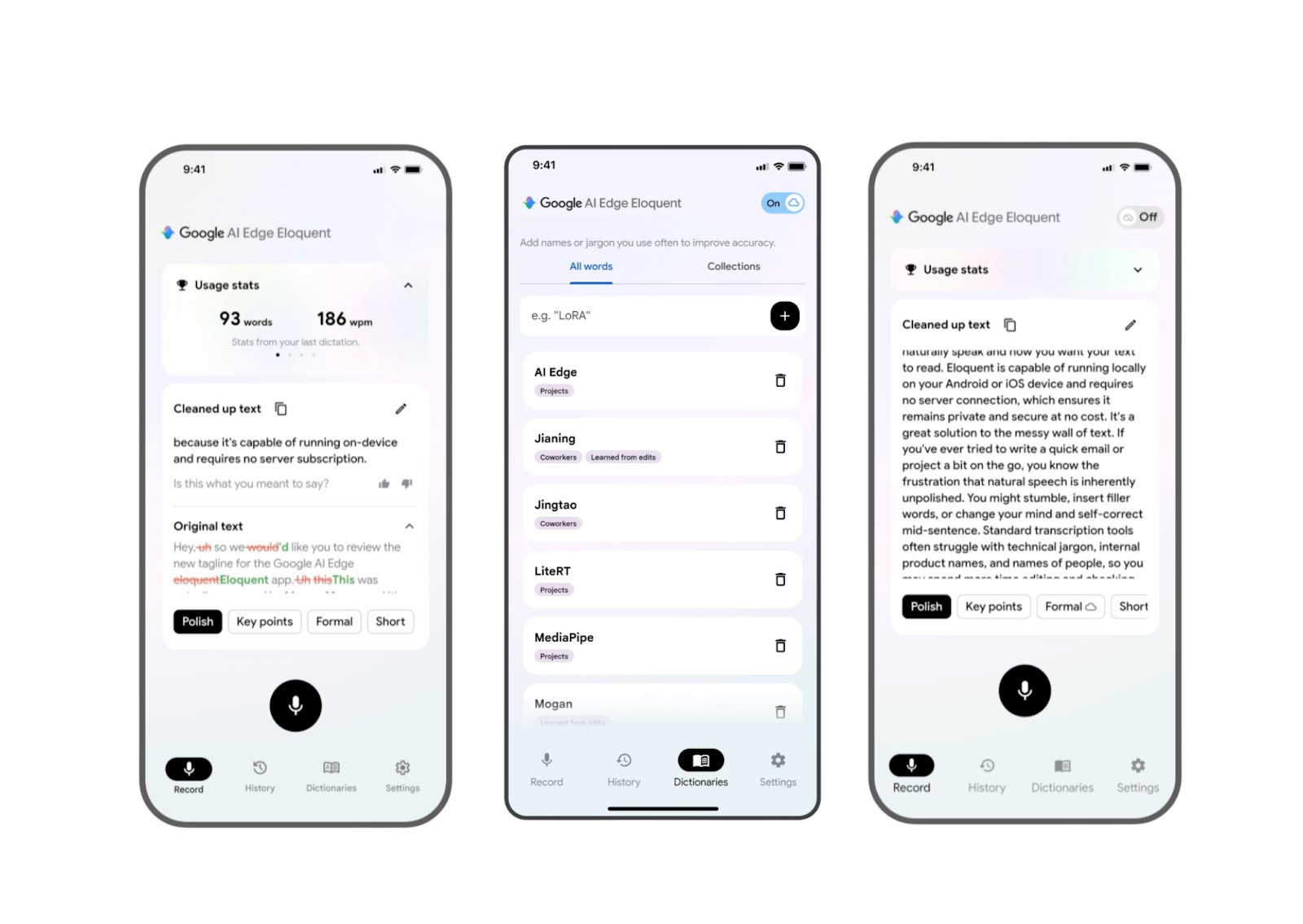
Google has announced the release of a new AI dictation application that operates without an internet connection, enhancing both functionality for users and privacy. The app, named Google AI Edge Eloquent, enables users to convert spoken language into polished text directly on their devices, eliminating the need to send voice data to the cloud.
This app represents a significant shift in the deployment of AI technologies, as it emphasizes on-device intelligence. Instead of relying solely on remote servers for processing, Google is moving toward embedding AI capabilities directly into devices, marking a new era for on-device AI.
Offline-first design emphasizes privacy
According to reports, the app utilizes Gemma-based speech recognition models, allowing it to function entirely offline once the necessary models are downloaded. This means users can dictate text with no internet connection required for its core functions.
In the App Store description, Google highlights that “Google AI Edge Eloquent is an advanced dictation app engineered to bridge the gap between natural speech and professional, ready-to-use text.” The app is designed to automatically eliminate filler words such as 'ums' and 'uhs', as well as self-corrections made during speaking.
Furthermore, the app includes a fully offline mode, ensuring that conversations remain on the device and enhancing user privacy. Users have the option to enable cloud-based Gemini models for additional text polishing, creating a hybrid model that leverages both local and cloud-based AI.
Features go beyond basic transcription
Google AI Edge Eloquent is not just a basic transcription tool; it aims to improve the quality of the text produced. The app restructures spoken input into more readable formats and provides editing capabilities that include options for "Formal," "Short," "Long," and "Key points."
Key features of the app include:
- Real-time transcription with automatic text cleanup.
- Clipboard-ready output for quick sharing capabilities.
- Usage metrics that track word count and speaking speed.
In addition to these features, users can customize vocabulary by importing terms from Gmail or adding their own specific jargon, enhancing the app’s accuracy for specialized tasks. The app also maintains a history of transcriptions, offering search and deletion functionalities.
Google has positioned this tool as providing “voice dictation without subscriptions,” with no usage caps, setting it apart from competitors who are exploring paid subscription models.
Availability and limitations
The app is currently available on the iOS platform and supports only the English language. However, Google has indicated that availability might be restricted in certain regions, such as the UK, Switzerland, and the European Economic Area, due to regulatory considerations, with plans for future expansion.
Additionally, Google has stated that it is evaluating the potential for the application to be available on other platforms, including desktop environments, with indications that deeper integration with Android could be on the horizon, potentially enabling system-wide dictation capabilities.
While the current release is labeled experimental, it underscores Google’s commitment to embedding AI directly into daily tasks while reducing reliance on constant internet connectivity.
As technology continues to evolve, this app could significantly streamline workflows, making dictation easier and more efficient for users everywhere.
Source: eWEEK News