

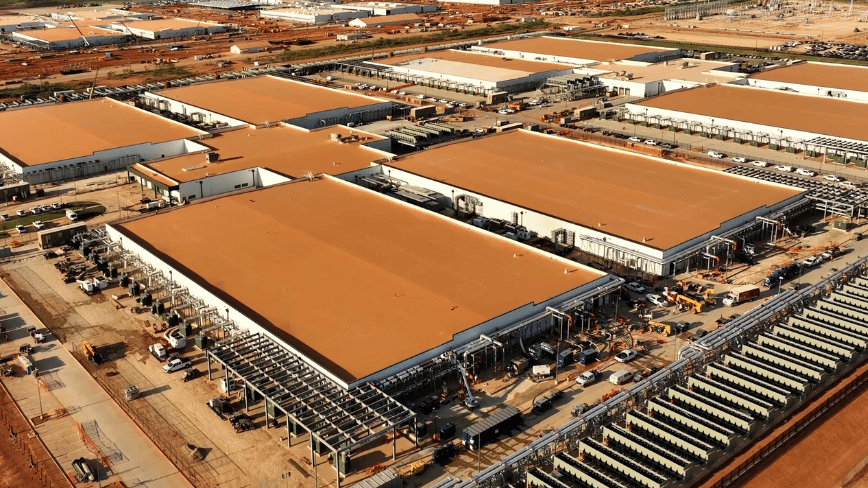
In short: Iran’s Islamic Revolutionary Guard Corps (IRGC) has released a video threatening 'complete and utter annihilation' of OpenAI’s $30bn Stargate AI campus in Abu Dhabi. The threat specifically names the facility for the first time, warning of retaliation if the US proceeds with its threats against Iranian civilian infrastructure.
A senior officer in the IRGC, Brigadier General Ebrahim Zolfaghari, has publicly vowed to destroy OpenAI’s flagship AI data centre located in Abu Dhabi. The video, released on April 3, 2026, begins with a blurred satellite view of the facility, transitioning to sharp night-vision footage of the expansive Stargate campus. A message displayed on the screen states: 'Nothing stays hidden to our sight, though hidden by Google.'
This video marks a significant shift in Iran's stance, as just days prior, the IRGC had identified 18 US technology companies, including Apple, Microsoft, Nvidia, and Tesla, as legitimate military targets, but did not specify any particular site. The Stargate video is the first instance where a specific installation has been threatened with destruction.
Zolfaghari indicated that the attack would be executed if the United States carries out President Donald Trump’s threats to bomb Iranian power plants and desalination facilities. While the threat is not immediate, it arises amid escalating tensions following a US-Israel joint campaign that commenced on February 28, 2026, which has led to Iranian retaliatory strikes against Gulf energy infrastructure and military installations, including data centres.
What is Stargate UAE?
Stargate UAE is the international flagship of the $500bn Stargate joint venture, which involves OpenAI, SoftBank, Oracle, and the Abu Dhabi sovereign investment vehicle MGX. The campus is currently under construction in the desert south of Abu Dhabi, covering approximately 19 square kilometres, and will be jointly operated by OpenAI and Oracle. SoftBank's involvement was bolstered by a $40bn bridge loan to support its commitment to OpenAI, arranged with JPMorgan Chase, Goldman Sachs, and three Japanese lenders in late 2025.
The first phase of the facility, a 200-megawatt compute cluster powered by Nvidia Grace Blackwell GB300 systems, is set to become operational by the end of 2026. Upon completion, the campus is expected to reach a total capacity of 1 gigawatt, with projected construction costs exceeding $30bn, according to the UAE’s AI minister. Reports suggest the facility could house up to 500,000 Nvidia GPUs, although this figure remains unverified. If successfully completed, Stargate UAE would represent the largest concentration of AI compute capacity outside the United States.
Key technology providers include Cisco, which is supplying zero-trust networking and connectivity infrastructure; Oracle, managing cloud operations; and Nvidia, as the primary chip supplier. The UAE government, through G42, retains construction and land interests, while OpenAI oversees model training and inference workloads.
A Conflict that Has Already Reached the Server Room
The threat to Stargate is not merely hypothetical. On March 1, 2026, Iranian Shahed drones targeted two Amazon Web Services (AWS) data centres in the UAE, damaging a third in Bahrain, which resulted in significant service disruptions for banking services, ride-hailing platforms, and payment processors across the Gulf. AWS subsequently waived usage fees for the entire month of March due to the impact of these attacks.
Additionally, Iran claimed responsibility for striking an Oracle data centre in Dubai on April 2, although Dubai’s media office denied the claim, leaving the actual status of that facility uncertain. The AWS drone strikes marked a historic precedent, being the first documented instance of a state intentionally targeting commercial data centres during an active military campaign, lending greater credibility to the current threats against Stargate.
The Stakes for Global AI Infrastructure
The timing of these developments is particularly concerning for the tech industry. Analysts from TD Cowen project that capital expenditure for hyperscalers will surpass $600bn in 2026, with a significant portion allocated to AI infrastructure development. The Gulf region, previously expected to be the fastest-growing data centre market globally, is now under scrutiny as tensions rise.
Insurers and institutional lenders are reassessing their risk models for infrastructure in the Middle East just as companies like Meta engage in substantial infrastructure deals, highlighting the urgent need for long-term capacity planning. A successful attack on Stargate, or even a sustained threat, could dramatically alter the landscape for future AI compute developments, potentially favoring regions like Northern Europe, India, and Southeast Asia.
One analyst indicated the dilemma succinctly: 'Previously, the assumption was that if the US struggled to build data centres, we would collaborate with allies in the Middle East. But who will insure a $20bn facility in the Middle East vulnerable to a $5,000 drone?' This conflict also raises critical questions about the interconnectedness of cybersecurity and AI infrastructure as vital strategic concerns.
OpenAI has remained silent regarding the threat. The company is navigating a complex period, especially with questions surrounding its partnership with Microsoft, particularly as Microsoft develops its own AI models to reduce dependence on any single collaborator. A halt or destruction of the Abu Dhabi facility would significantly impact OpenAI's expansion plans outside the United States.
As of April 6, 2026, Iran has yet to act on its specific threat, and ceasefire negotiations remain stalled. Iran has dismissed a US proposal for a temporary cessation of hostilities, while President Trump continues to threaten Iranian civilian infrastructure. The $30bn campus in the desert now stands at the crossroads of two conflicts: one kinetic, fought with drones and missiles, and another strategic, concerning control over the computing power that will drive the next decade of artificial intelligence. The outcome of these tensions may hinge on decisions made in the coming weeks.
Source: TNW | Amazon News