

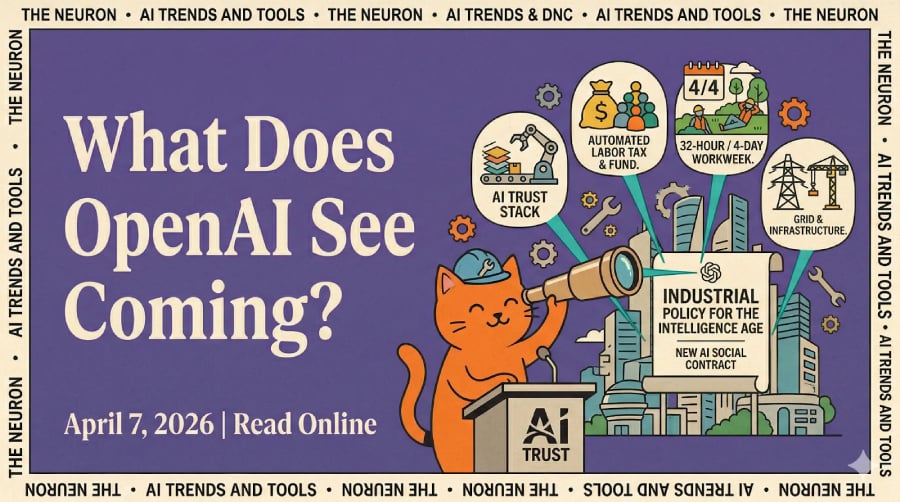
OpenAI has recently pointed to an imminent shift in the landscape of artificial intelligence, signaling that we may be closer to a major transformation than many realize. Following a leadership reshuffle focused on AGI deployment and new developments on its upcoming model, codenamed 'Spud,' the company has released a policy paper that feels more like a wake-up call than a mere thought exercise.
In its paper titled 'Industrial Policy for the Intelligence Age,' OpenAI posits that minor adjustments in policy will not suffice if superintelligent AI begins to impact jobs, taxation, public systems, cyber defense, and biosecurity simultaneously. This 13-page document is designed to provoke discussion rather than serve as a final policy blueprint.
The organization draws parallels between the current situation and the Industrial Age, noting that significant societal changes, such as the Progressive Era and the New Deal, were necessary to adapt to advancements in electricity, mass production, and modern industry. OpenAI suggests that a similar ambitious restructuring may be required for AI.
A Few Key Proposals
- Shift the tax structure away from labor towards capital and corporate income, potentially introducing taxes linked to automated labor. This could be complemented by tools like a public wealth fund to ensure that citizens benefit from the advancements of AI.
- Transform productivity gains into additional leisure time through initiatives like a 32-hour workweek and a four-day work week pilot, alongside portable benefits and safety nets that activate automatically in response to AI-induced disruptions.
- Enhance infrastructure and oversight, advocating for faster grid expansion, the creation of an 'AI trust stack,' stronger auditing mechanisms, incident reporting procedures, and increased public participation in governance of powerful AI systems.
This shift in tone from OpenAI is significant; the organization is moving from a lab-focused approach to a more urgent plea for careful consideration from policymakers. OpenAI's message suggests that AI could evolve rapidly enough to strain payroll-tax-funded programs, disrupt labor-market standards, and necessitate a complete overhaul of wealth distribution systems.
This statement transcends the popular discourse around a 'robot tax' and aims to elevate the discussion surrounding AI policy. OpenAI is proactively seeking to influence policy through fellowships, research grants up to $100,000, API credits totaling $1 million, and plans for a workshop in Washington, D.C.
Initial reactions have been striking, with commentators expressing both surprise and skepticism. Axios characterized it as a tech leader outlining how the government should approach taxation, regulation, and wealth redistribution linked to the very technology they are developing. Business Insider highlighted the most provocative elements: automated labor taxes, a public wealth fund, and the concept of a four-day work week. The Wall Street Journal interpreted these moves as part of OpenAI's broader strategy to shape the forthcoming policy debate surrounding AI.
While skepticism about OpenAI's motives is understandable, the urgency of the topic cannot be overstated. By positioning itself at the forefront of this discourse, OpenAI is advocating for a necessary conversation that goes beyond partisan divides. This is a time for collaborative solutions rather than competitive posturing.
Our Perspective
If leading AI labs are transitioning from a mindset of 'please don’t slow us down' to one advocating for a redesign of labor, welfare, infrastructure, and oversight policies, it indicates that this discussion has moved beyond theoretical realms. Such dialogue is overdue, and OpenAI's willingness to take the initiative is commendable. We hope that this encourages others to join the conversation, as this moment calls for constructive solutions rather than divisive rhetoric.
Source: eWEEK News